Case guide
Female serial killers.
Twelve documented American cases, what the research found about women who kill repeatedly, and why the most famous of them, Aileen Wuornos, is the exception rather than the rule.
Female serial killers are rarer than male ones, and most of what people think they know comes from one case, Aileen Wuornos, and that case is the exception, not the rule. This page puts twelve documented American cases side by side, from the 1890s to 2008, and sets them against what the research actually found about how and why women kill repeatedly.
Every person below was convicted, or was found not guilty by reason of insanity after a trial, or is long dead. Each fact is checked against at least two independent sources, listed at the end. Where the sources disagree on a date or a count, the page says so instead of picking one quietly.
What the research found
The most-cited study is by Marissa Harrison and colleagues at Penn State Harrisburg, published in 2015 in the Journal of Forensic Psychiatry & Psychology. They compiled 64 women whose killings took place in the United States between 1821 and 2008, working from media reports, and looked for what the cases had in common.
- Method. Poisoning was the most common method. (No source we could check gives a reliable percentage, so we don't print one.)
- Motive. Financial gain was the most common motive.
- Victims. Most of the women knew all or most of their victims, and most were related to them. In every case at least one victim was a child, an elderly person or someone infirm.
- Work. Nearly 40 percent worked in health care, as nurses or aides.
- Mental illness. Nearly 40 percent had some form of mental illness.
- Profile. They were typically white, educated, had been married and held a caregiving role, as a mother or a health worker.
That is close to the opposite of the popular picture of a serial killer. The men in the famous cases mostly hunt strangers. The women in this sample mostly killed people who trusted them, quietly, often for money, and often for years before anyone noticed.
Black widows and angels of death
Two labels come up again and again, and they describe the two patterns above.
- Black widow: a woman who kills several husbands, partners or relatives, usually for financial gain. It is the motive, not the method, that defines the type, although the method is very often poison. Nannie Doss, Judy Buenoano and Velma Barfield, below, fit it.
- Angel of death (sometimes “angel of mercy”): a nurse, aide or other caregiver who deliberately harms or kills the people in their care. Jane Toppan, Genene Jones, Kristen Gilbert, Gwendolyn Graham and Cathy Wood, and Kimberly Saenz fit it.
The earliest cases: Lizzie Halliday and Jane Toppan
Lizzie Halliday, born Eliza Margaret McNally in County Antrim, Ireland, about 1859, lived on a farm in Sullivan County, New York. When her husband Paul went missing, neighbours grew suspicious; a search of the farm found the bodies of two women, Margaret and Sarah McQuillan, who had been shot, and a few days later Paul Halliday's body under the floorboards. Most sources date this to September 1893; Wikipedia gives 1891. In June 1894 she was convicted of murder and became the first woman sentenced to death in the electric chair. The governor, Roswell P. Flower, commuted the sentence after a medical commission found her insane, and she was committed to the Matteawan State Hospital. In 1906 she killed a nurse there, Nellie Wicks. She died at Matteawan in June 1918. Her full case file is here.
Jane Toppan, born Honora Kelley in Boston (in 1854 by most accounts, 1857 by one), was a nurse who poisoned patients and acquaintances with morphine and atropine over a period of years, by one account as many as fifteen. After several deaths in the Davis family at Cataumet on Cape Cod in 1901, relatives pushed for an investigation; an exhumation found morphine. She was arrested in Amherst, New Hampshire, on 29 October 1901. She confessed to 31 killings and told doctors the real number might be close to a hundred. At her trial in Barnstable in June 1902 she was found not guilty by reason of insanity and committed for life to the state hospital at Taunton, where she died in August 1938.
The black widows: Nannie Doss, Velma Barfield, Judy Buenoano
Nannie Doss was born in Blue Mountain, Alabama, in 1905. From about 1927 to 1954, in Alabama, North Carolina, Kansas and Oklahoma, she put arsenic in the food and drink of the people around her. She met several of her husbands through lonely-hearts advertisements. When her fifth husband, Samuel Doss, died in Tulsa in 1954, a doctor grew suspicious and obtained an autopsy that found a large amount of arsenic. She was arrested in October 1954 and confessed to poisoning four of her five husbands; she was also suspected in the deaths of relatives, among them her mother, a sister, children and a grandson, about eleven or twelve deaths in all. In May 1955 she pleaded guilty to Samuel Doss's murder and was sentenced to life. The press called her the “Giggling Granny”. She died of leukemia in the Oklahoma State Penitentiary at McAlester on 2 June 1965.
Velma Barfield, born in October 1932, poisoned people in North Carolina with arsenic from the late 1960s until 1978. She was convicted of the first-degree murder of her fiancé, Rowland Stuart Taylor, and sentenced to death. She confessed to other poisonings, including her own mother; sources disagree on whether she admitted three other killings or four. On 2 November 1984 she was executed by lethal injection at Central Prison in Raleigh, the first woman executed in the United States after capital punishment resumed in 1976, and the first woman executed by lethal injection.
Judy Buenoano, born in Texas in 1943, poisoned her husband James Goodyear with arsenic and drowned her son Michael; she was convicted of both murders. The dates differ between sources: most put Goodyear's death in 1971 and Michael's in 1980, while the federal court's own history of the case gives 1965 and 1979. What brought her down was a car bomb in 1983 that injured her boyfriend, John Gentry, who survived; evidence at her home tied her to the bomb, and investigators went back to the earlier deaths. She was also suspected in the 1978 death of a boyfriend in Colorado, but never charged. She was executed in Florida's electric chair on 30 March 1998, the first woman executed in the state since 1848. The federal court's page on the case is titled simply “The Black Widow”.
The exception: Aileen Wuornos
Aileen Wuornos shot seven men on Florida highways in 1989 and 1990, was convicted of six of the murders and executed by lethal injection on 9 October 2002. She is the most famous female serial killer in America precisely because she did not fit the pattern: she killed strangers, with a gun, by the roadside. Her case file goes through the victims and the trials.
The landlady: Dorothea Puente
Dorothea Puente, born in 1929, ran a boarding house on F Street in Sacramento for elderly and disabled tenants. From 1982 to 1988 she drugged tenants, buried them in the yard and went on cashing their government benefit cheques. In November 1988 a social worker looking for a missing tenant alerted police, and digging in the yard began; seven bodies were recovered there. Puente left for Los Angeles during the search and was arrested a few days later. She was tried for nine murders in 1993 and convicted of three, two in the first degree and one in the second; the jury deadlocked on the other six. She was sentenced to life without parole and died in prison at Chowchilla on 27 March 2011, aged 82.
The angels of death: Genene Jones, Kristen Gilbert, Graham and Wood, Kimberly Saenz
Genene Jones was a licensed vocational nurse in the pediatric ICU of the Bexar County Hospital in San Antonio, and then at a pediatric clinic in Kerrville, Texas, in 1982. She injected infants and children with drugs, including the paralytic succinylcholine. In 1984 she was convicted of murdering 15-month-old Chelsea McClellan and sentenced to 99 years. When a Texas good-conduct law put her on course for release in March 2018, prosecutors brought new charges, and in January 2020 she pleaded guilty to the 1981 murder of 11-month-old Joshua Sawyer and was sentenced to life. She is suspected in many more deaths; estimates vary so widely between sources that we don't print a number. Her case file covers the CDC study that exposed the “Death Shift”.
Kristen Gilbert was a nurse at the VA Medical Center in Northampton, Massachusetts. In 1996 fellow nurses reported a rise in cardiac arrests and missing supplies of epinephrine, which she had been injecting to cause cardiac arrest. Because the hospital was federal property the case went to federal court, where prosecutors could seek the death penalty even though Massachusetts had none. In March 2001 a federal jury convicted her of four murders and two attempted murders, and of a bomb threat she made during the investigation; the jury rejected death, and she was sentenced to life without parole.
Gwendolyn Graham and Cathy Wood were nurse's aides at the Alpine Manor nursing home in Walker, near Grand Rapids, Michigan. In 1987 they smothered five elderly women patients. The case came to light in 1988, after Wood told her ex-husband and the information reached the police. Wood made a plea deal, testified against Graham and was sentenced to 20 to 40 years for second-degree murder; she was released in January 2020. Graham was convicted on five counts of murder and one of conspiracy and sentenced to life without parole in 1989.
Kimberly Saenz was a licensed vocational nurse at a DaVita dialysis clinic in Lufkin, Texas. In April 2008 two patients saw her draw bleach into syringes and inject it into other patients' dialysis lines, and reported it; tests found bleach in the lines. In 2012 an Angelina County jury convicted her of capital murder in the deaths of five patients, together with aggravated assault on others, and sentenced her to life without parole after declining the death penalty. (Sources describe the counts differently, as one capital murder count or as five, because in Texas one capital count can cover several victims.)
A mother: Marybeth Tinning
Marybeth Tinning of Schenectady, New York, lost child after child between 1972 and 1985: eight or nine, depending on whether the first death is counted as natural. After her four-month-old daughter Tami Lynne died in December 1985, she admitted under police questioning in 1986 to smothering Tami Lynne and two of her sons. She was convicted in 1987 only of the second-degree murder of Tami Lynne and sentenced to 20 years to life. The other deaths were never charged. She was granted parole at her seventh hearing, in July 2018, and released that August.
Who was the first female serial killer in America?
Not Aileen Wuornos, although after her 1991 arrest she was widely called that. The label was wrong. Halliday was convicted in 1894 and Toppan confessed in 1901. Doss pleaded guilty in 1955, and Barfield was executed in 1984, six years before Wuornos was arrested. The Harrison study alone includes cases going back to 1821. Belle Gunness, whose Indiana farm gave up the remains of men she had lured with matrimonial advertisements after her house burned in April 1908, is another early case, though she was never tried and what happened to her has never been settled.
The name most often offered as “the first”, Lavinia Fisher of Charleston, hanged in 1820, is a myth of its own: she and her husband were convicted of highway robbery, not murder, and historians doubt she killed anyone. The honest answer is that no one can reliably be named the first. Documented cases go back at least to the nineteenth century.
More case files on this site
- Aileen Wuornos: seven men, six death sentences, and the myth of the “first female serial killer”.
- Genene Jones: the nurse behind San Antonio's “Death Shift”.
- Lizzie Halliday: the first woman sentenced to the electric chair.
- Christine Falling: the babysitter whose victims were ruled natural deaths.
The books
We made two books about American women who killed: one to color, one to read.
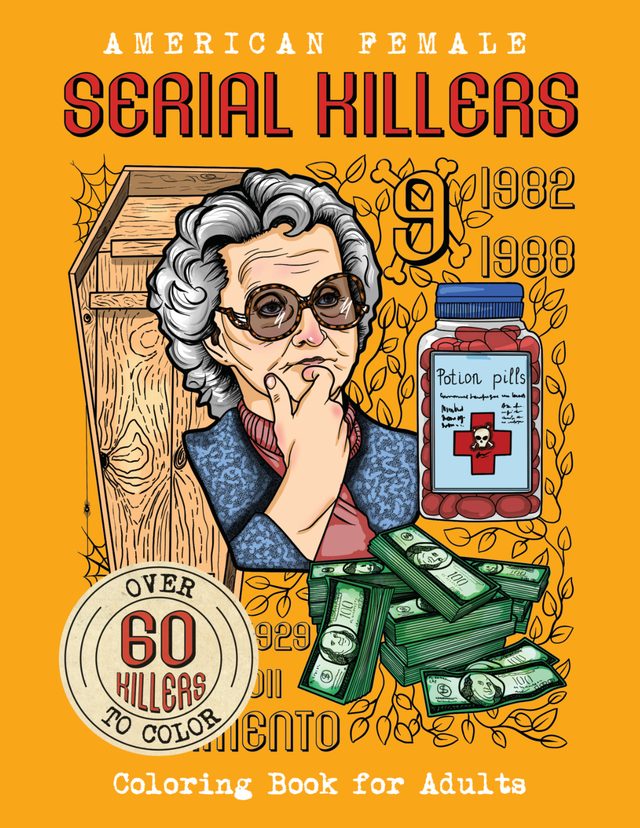
American Female Serial Killers
Sixty women who killed, drawn one to a page by hand, each with the facts of the case set alongside: the victims, the weapons, the places, the years.
128 pages · 4.8 / 5 from 1,330 ratings · Buy on Amazon

American Female Serial Killers: The Encyclopedia
The reference volume that grew out of the coloring book: names, dates, methods and outcomes, the whole record in one place. Text, no pictures.
145 pages, text · 4.4 / 5 from 173 ratings · Buy on Amazon
Questions people ask
Who was the first female serial killer in America?
No one can reliably be named the first. Aileen Wuornos was often called that after 1991, wrongly: Lizzie Halliday was convicted in 1894, Jane Toppan confessed to 31 killings in 1901, and a 2015 study includes cases back to 1821. Lavinia Fisher, hanged in 1820, is also often named, but she was convicted of highway robbery, not murder.
How do female serial killers usually kill?
Poisoning is the most common method, according to a 2015 study of 64 American female serial killers by Marissa Harrison and colleagues. Most knew their victims, and financial gain was the most common motive.
What is a black widow killer?
A woman who kills several husbands, partners or relatives, usually for financial gain. Nannie Doss, who poisoned four of her five husbands with arsenic, and Judy Buenoano are well-known examples.
What is an angel of death?
A nurse or other caregiver who deliberately kills people in their care. Nearly 40 percent of the women in the 2015 Harrison study worked in health care. Examples include Jane Toppan, Genene Jones, Kristen Gilbert and Kimberly Saenz.
Who was the first woman executed after the death penalty returned in 1976?
Velma Barfield, executed by lethal injection in North Carolina on 2 November 1984 for poisoning her fiancé with arsenic. She was also the first woman executed by lethal injection.
Was Aileen Wuornos a typical female serial killer?
No. She shot strangers, men she met by the roadside, which is close to the opposite of the usual pattern of poison, known victims and a financial motive.
Four free pages, by email
Four sample pages from the back of the books are free by email — print them and see how the drawings color before you buy.
One email to confirm it’s you. Click the link in it and the pages arrive. No spam, unsubscribe in one click — see the privacy notice.
Check your inbox and click the confirmation link — the pages land right after. Nothing within a few minutes? Look in your spam folder.
Sources
Every date and name on this page was checked against at least two of the following. Where they disagree, the disagreement is stated in the text rather than resolved silently.
- Harrison et al., Female serial killers in the United States: means, motives, and makings (abstract)Journal of Forensic Psychiatry & Psychology, 2015, via Penn State
- The psychology of female serial killersBPS Research Digest
- Why female serial killers are different (Marissa Harrison)TIME / The Conversation, 2015
- Just as deadly: inside the mind of a female serial killerPenn State News, 2023
- Access and attention: why serial killers often work in healthcareThe Conversation, 2023
- Black widows and other female serial killersPsychology Today (Scott Bonn), 2015
- Why are female killers called black widows?Oxygen
- Healthcare serial killers: a reviewMenshawey & Menshawey, 2022 (PMC)
- Was Aileen Wuornos the first female serial killer?Biography.com
- Is Aileen Wuornos the queen of serial killers? (Katherine Ramsland)Psychology Today, 2025
- A short history of serial killer Lizzie HallidayNew York Almanack, 2014
- Lizzie HallidayIrishCentral
- Jolly Jane ToppanThe West End Museum
- Jane ToppanBoston Magazine, 2015
- Toppan, Jane (1854–1938)Encyclopedia.com
- Nannie DossEncyclopedia of Alabama
- Barfield, Margie VelmaNCpedia
- Velma Barfield, serial killerNorth Carolina Department of Natural and Cultural Resources, 2016
- The Black WidowUS District Court, Middle District of Florida
- Florida woman dies in electric chair (AP)Deseret News, 30 March 1998
- Dorothea Puente dies in prison (AP)NBC News, 2011
- Prosecutors race to keep “Angel of Death” behind barsProPublica
- Texas baby killer pleads guilty to a new murderProPublica, January 2020
- Marybeth Tinning granted paroleSpectrum News, July 2018
- Marybeth Tinning paroledCBS New York, 2018
- Killer nurse gets lifeCBS News, 2001
- A nurse's aide gets life imprisonmentHistory.com, This Day in History, 2 November
- Ex-nurse convicted of bleach killings sentenced to lifeCBS News, 2012
- Saenz sentenced to life for dialysis patient deathsUS Attorney's Office, Eastern District of Texas, April 2012
- Chronicling America: Belle Gunness and the murder farmLibrary of Congress
- Lavinia Fisher: America's first female serial killer that wasn'tSYFY Wire
- Angel of mercy (criminology)Wikipedia