Case file
Ed Gein: the true story of the Plainfield grave robber behind Psycho
He killed two women and robbed about nine graves in a small Wisconsin town, and the things found in his farmhouse in November 1957 went on to shape Psycho, Leatherface and Buffalo Bill. The record is stranger, and smaller, than the legend.
- BornEdward Theodore Gein, 27 August 1906, La Crosse, Wisconsin
- HomeAn isolated farm outside Plainfield, Waushara County
- KillingsTwo confirmed: Mary Hogan (1954) and Bernice Worden (1957)
- Graves robbedAbout nine, 1947–1952, by his own account
- ArrestedEvening of 16 November 1957, West Plainfield
- Verdict1968: guilty of Worden's murder, but legally insane
- Died26 July 1984, Mendota Mental Health Institute, Madison, aged 77
Ed Gein is one of the most famous names in American crime, and one of the most misunderstood. He is remembered as a serial killer who inspired three of the best-known villains in horror. The documented record is smaller and in some ways stranger: two women killed, about nine graves robbed, and a farmhouse in Plainfield, Wisconsin, where what investigators found in November 1957 shocked the country.
This page follows that record, and leaves out the invented parts, including several that Netflix's 2025 series Monster: The Ed Gein Story added. Where sources disagree on a date, an age or a count, the page says so or leaves the number out. It describes what was found in the house plainly and without dwelling on it.
A farm outside Plainfield
Edward Theodore Gein was born on 27 August 1906 in La Crosse, Wisconsin, the younger of two sons of George and Augusta Gein. His father is described as an alcoholic; his mother as domineering and fiercely religious, and determined to keep her sons away from other people, above all from women. Around 1914–15 the family left La Crosse for an isolated farm outside Plainfield, in Waushara County.
George Gein died of heart failure in 1940. On 16 May 1944 Ed's older brother Henry died, aged 43, during a fire on or near the property. The death was treated as an accident; there was no autopsy and no formal investigation. The cause is recorded differently, as asphyxiation or as heart failure, and later writers, among them the biographer Harold Schechter, have questioned it. It was never proven that Ed had anything to do with it, and he never confessed to it.
Augusta Gein had a series of strokes and died on 29 December 1945. After that Ed lived alone on the farm. He sealed off his mother's rooms and left them as they were; the rest of the house fell into squalor, without electricity or indoor plumbing.
The graves, 1947 to 1952
By his own later account, between 1947 and 1952 Gein made about forty night-time visits to local cemeteries, often, he said, in a kind of daze. On most of them he left without taking anything. He admitted robbing about nine graves, most of them of middle-aged women who had recently been buried, at Plainfield Cemetery, Spiritland Cemetery in Portage County and Hancock Cemetery. (One 1984 wire report says about a dozen graves, over a longer span; most accounts give nine, or “nine or ten”.)
Mary Hogan, 1954
On 8 December 1954 Mary Hogan, a tavern keeper in her fifties (her age is given as 51 or 54), disappeared from her tavern in the town of Pine Grove, in Portage County. Blood and a spent cartridge were found in the tavern, but the case went nowhere for three years. Her remains were eventually found in Gein's house, and he admitted shooting her. He was never charged with her murder; the judge in his case later wrote that he was tried for only one killing because of the cost.
16 November 1957: Bernice Worden
On the morning of Saturday 16 November 1957, the opening day of deer season, Bernice Worden, 58, who owned the hardware store in Plainfield, disappeared from it. She had been shot with a .22-calibre rifle. Late that afternoon her son, Frank Worden, a deputy sheriff, came to the store and found the register open and blood on the floor.
He told investigators that Gein had been in the store the evening before and had said he would come back for antifreeze. The last receipt his mother had written that morning was a sales slip for antifreeze. Gein was arrested that same evening in West Plainfield, where he was having supper with the family of the local grocer. Officers searching his farm that night found Bernice Worden's body in a shed on the property.
What the search found
The search of the farmhouse is the reason Gein is still remembered. Investigators found human remains throughout the house: skulls, some made into bowls; furniture and a wastebasket covered with human skin; masks made from the facial skin of women; and a garment made of skin. The remains of Mary Hogan and of Bernice Worden were among the finds. Accounts differ on how many people the remains came from, so this page does not give a number.
Gein told investigators that most of what they found came from the graves, not from killings. In late November 1957 investigators opened graves he had pointed out at Plainfield Cemetery and found them empty or disturbed, which confirmed his account. (Sources disagree on whether two or three graves were opened.) A panel of doctors diagnosed him with schizophrenia.
Insane, then guilty but insane
Gein was charged with the first-degree murder of Bernice Worden and pleaded not guilty by reason of insanity. In January 1958 he was found mentally incompetent to stand trial and committed to the Central State Hospital for the Criminally Insane at Waupun.
Ten years later doctors found him competent. In November 1968 he was tried without a jury before Judge Robert H. Gollmar, who found him guilty of Worden's murder and then, in a second phase, not guilty by reason of insanity. He was sent back to Central State Hospital for the rest of his life. (A few accounts, including one 1984 wire story, say he was never convicted; the usual description is guilty but legally insane.)
The house, the car and the grave
The farm was due to be auctioned on 30 March 1958. In the early hours of 20 March the farmhouse burned to its foundation. Arson was suspected, but the cause was never officially determined and no one was charged. Gein's Ford sedan, which he had used to move bodies, was sold at the auction for $760 to a carnival sideshow operator, Bunny Gibbons, who toured it as the “Ed Gein Ghoul Car” at 25 cents a look. What happened to it afterwards is not known. The site is private farmland today.
A petition for release in 1974 was denied. In 1978 Gein was moved to the Mendota Mental Health Institute in Madison, and he died there on 26 July 1984, aged 77, of respiratory failure; he also had cancer. He was buried in Plainfield Cemetery beside his mother and brother. (One 1984 wire story says Spiritland Cemetery, which was one of the cemeteries he had robbed; later sources, including Wisconsin Public Radio, say Plainfield.) Souvenir hunters chipped at his gravestone, and in 2000 it was stolen; it was recovered near Seattle in 2001 but never put back, and the grave is unmarked.
Was Ed Gein a serial killer?
He is usually called one, but the label is argued over. Only two killings are confirmed, Mary Hogan and Bernice Worden. Older definitions of serial murder required three or more victims; the FBI's current definition, published in 2008, requires two or more killings in separate events, which Gein's case meets.
Police at the time suspected him in other disappearances, and could never tie him to any of them. He was questioned about Evelyn Hartley, a 15-year-old babysitter who disappeared in La Crosse in October 1953; he denied it, nothing ever linked him to the case, and it remains unsolved. He was also suspected, and never linked, in the 1952 disappearance of two deer hunters who had left a Plainfield bar, and in the 1947 disappearance of eight-year-old Georgia Jean Weckler in Fort Atkinson.
Psycho, Leatherface and Buffalo Bill
Robert Bloch, a writer living in Weyauwega, less than an hour from Plainfield, published the novel Psycho in 1959, and Alfred Hitchcock's film followed in 1960. Gein is widely cited as an influence on Norman Bates, the quiet man in thrall to his dead mother. Bloch himself said he had mostly written the book before he learned the details of Gein's case, and later remarked on how close the resemblance turned out to be.
Tobe Hooper, who directed The Texas Chain Saw Massacre (1974), said he had heard about Gein as a child from relatives; Leatherface's masks of human skin come from the case. Gein never used a chainsaw. Buffalo Bill in The Silence of the Lambs (film, 1991) also drew partly on Gein.
Monster: what the Netflix series gets wrong
Monster: The Ed Gein Story, the third season of Ryan Murphy and Ian Brennan's Netflix anthology, premiered on 3 October 2025, with Charlie Hunnam as Gein and Laurie Metcalf as Augusta. Several outlets that checked it against the record, among them Biography.com, Rolling Stone and TheWrap, found that much of it is invented:
- It shows Ed killing his brother Henry. Henry's death was ruled accidental, and no murder was ever proven.
- It shows killings beyond the two confirmed ones, including the missing hunters and Evelyn Hartley. There is no evidence for any of them.
- It shows Gein helping investigators catch Ted Bundy. That never happened; Schechter called it “wildly, wildly made up”.
- It gives him a long romance with a local woman who, in 1957, told a newspaper that reports of a twenty-year romance were exaggerated and untrue.
- Its death scene is invented. He died of respiratory failure in a hospital.
The series brought a new wave of visitors to Plainfield. In October 2025 the village board asked people to respect private property and said it does “not endorse or want to encourage tourism related to these historical tragedies”.
Questions people ask
What is the true story of Ed Gein?
Ed Gein lived alone on a farm outside Plainfield, Wisconsin, after his domineering mother died in 1945. Between 1947 and 1952 he robbed about nine graves. He killed Mary Hogan in 1954 and Bernice Worden in 1957, was arrested on 16 November 1957, was found insane, and spent the rest of his life in state mental hospitals. He died in 1984.
How many people did Ed Gein kill?
Two are confirmed: Mary Hogan, a tavern keeper, in 1954 and Bernice Worden, the Plainfield hardware store owner, in 1957. He was suspected in other disappearances but was never linked to any of them. Separately, he admitted robbing about nine graves.
How was Ed Gein caught?
Bernice Worden's son, a deputy sheriff, found blood in her store on 16 November 1957. Gein had said he would come back for antifreeze, and her last sales slip that morning was for antifreeze. He was arrested that evening and her body was found at his farm.
What did they find in Ed Gein's house?
Human remains throughout the house, including skulls, furniture and objects covered with human skin, masks made from women's faces and a garment made of skin, as well as the remains of his two victims. Most of it came from graves he had robbed.
Was Ed Gein convicted?
In 1968 a judge found him guilty of Bernice Worden's murder but legally insane, and he was committed to a state mental hospital. He had earlier been found unfit to stand trial, in 1958. He was never tried for Mary Hogan's death.
Where is Ed Gein buried?
In Plainfield Cemetery in Plainfield, Wisconsin, beside his mother and brother. His gravestone was stolen in 2000 and, although recovered in 2001, was never replaced, so the grave is unmarked.
Is Monster: The Ed Gein Story accurate?
Only in outline. Fact-checks by Biography.com, Rolling Stone and others found that it invents the murder of his brother, extra victims, a role in catching Ted Bundy and a long romance.
The page this portrait comes from

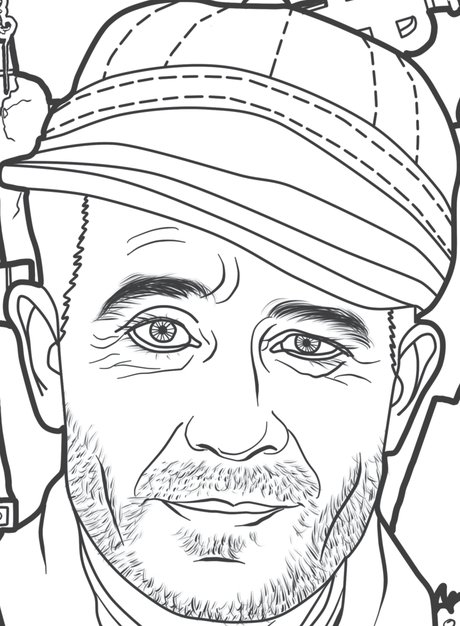
The full page — Ed Gein at the size you color him, with the case details drawn in around the portrait — is in Bloody Alphabet. Twenty-three killers, one to a letter, each drawn as a full-page portrait with the objects and details of the case around it.
Get the next one first
New books go out to this list before they go anywhere else. Joining also gets you the four sample pages from the back of the books — print-quality, single-sided.
One email to confirm it’s you. Click the link in it and the pages arrive. No spam, unsubscribe in one click — see the privacy notice.
Check your inbox and click the confirmation link — the pages land right after. Nothing within a few minutes? Look in your spam folder.
Sources
Every date and name on this page was checked against at least two of the following. Where they disagree, the disagreement is stated in the text rather than resolved silently.
- Ed GeinBiography.com, updated October 2025
- Monster: The Ed Gein Story, true vs falseBiography.com, October 2025
- Was Ed Gein a serial killer? What we know about his victimsBiography.com, October 2025
- Ed Gein's farmhouseBiography.com, October 2025
- Body of Ed Gein's final victim, Bernice Worden, is foundHistory.com, This Day in History
- Infamous serial killer Ed Gein diesHistory.com, This Day in History
- Explainer on Ed Gein (Chris Foran)Milwaukee Journal Sentinel, August 2025
- From Psycho to Leatherface (Chris Foran)Milwaukee Journal Sentinel, 2025
- 'Psycho' dies in mental institutionUPI, 26 July 1984
- 'Psycho' inspiration Ed Gein diesUPI, 27 July 1984
- 'Butcher of Plainfield' buried near motherUPI, 1 August 1984
- The tale of 'Psycho' killer Ed GeinUPI, 16 November 1982
- Our Psycho (Scott Hassett)Isthmus, Madison, 30 November 2007
- A look back at the Plainfield Butcher (Joe Hanneman)Hanneman Archive, 2014
- Ed GeinEBSCO Research Starters
- How Ed Gein diedTODAY, October 2025
- What happened to Ed Gein's houseTODAY, October 2025
- How Ed Gein inspired The Texas Chain Saw MassacreTODAY, October 2025
- What Monster: The Ed Gein Story gets right and wrong (Elizabeth Yuko)Rolling Stone, October 2025
- Did Ed Gein help catch Ted Bundy?TheWrap, October 2025
- How accurate is Monster: The Ed Gein Story?History vs Hollywood
- Mary Hogan: Ed Gein's first victimCrime+Investigation UK
- Evelyn Grace HartleyThe Charley Project
- The cold case of Evelyn HartleyUpNorthNews, November 2025
- Village of Plainfield responds to new Ed Gein show on NetflixWaushara Argus, October 2025
- Haunted WisconsinWisconsin Public Radio
- 16 November 1957: Ed Gein arrested in PlainfieldWSAW-TV, November 2025
- Ed GeinWikipedia
- Monster: The Ed Gein StoryWikipedia
The facts on this page come from public records and the published sources above. If you find an error, write to hello@truecrimeart.com and it will be corrected.
More case files
- The Zodiac Killer: five murders, four ciphers and a case that is still openFour attacks, seven victims, five dead. Then five years of letters and ciphers to the San Francisco papers,…
- Aileen Wuornos: seven men, six death sentences, and the myth of the “first female serial killer”She was billed as America's first female serial killer. She was not. What she was is documented in four…
- Graham Young: the Teacup Poisoner who was let out to poison againAt fourteen he poisoned his family and was sent to Broadmoor. Eight years later his doctor recommended his…